
Bids and proposals · 4 min read
Most B2B proposals are written by Chad.
In your proposal, you see evidence of expertise. Your buyer sees a company talking about itself.
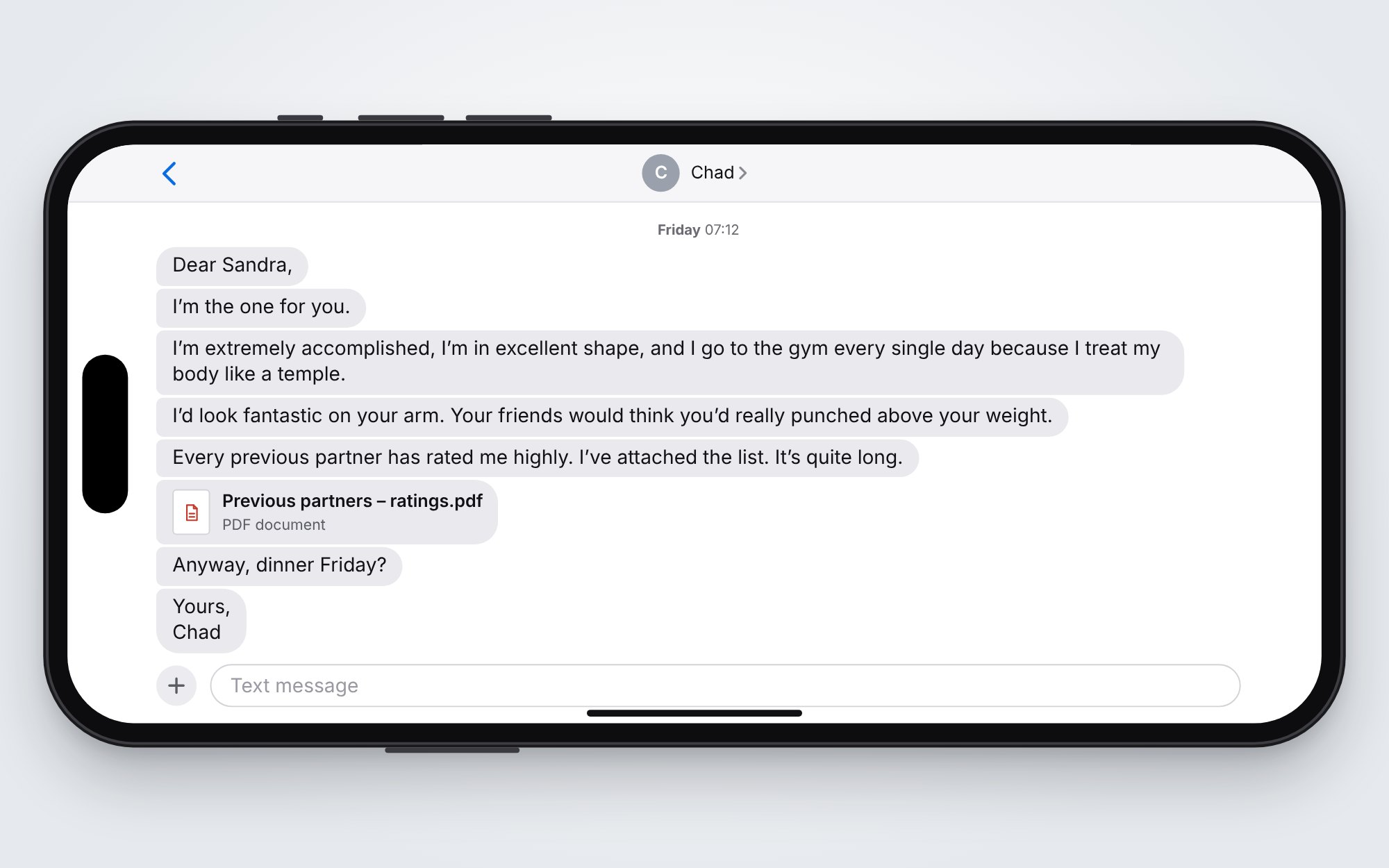
Imagine an admirer sends you the love letter above.
Nobody wants to be Sandra reading that letter. It isn’t romantic. It’s a résumé with cologne on it.
Chad hasn’t asked Sandra a single question about what she likes, what she’s worried about or what would actually make her evening. He’s hoping his credentials will do the work.
You’d never send that letter. You’d laugh at anyone who did.
Now open the last proposal you sent.
Chad writes proposals for a living.
Most B2B proposals we see follow the same running order. It looks something like this.
A typical B2B proposal, contents page
- About us
- Our history
- Our global footprint
- Our awards and accreditations
- Our methodology
- Our team
- Our case studies
- Commercials
Count the pages about the buyer. Often there aren’t any. If there is one, it’s usually called something like “Our understanding of your requirements”, and even that is written in our words, not theirs.
Read it next to Chad’s letter and the parallels are hard to miss. “I’m extremely accomplished” is the company history. “I’m in excellent shape” is the market-leading platform. “Your friends would think you’d really punched above your weight” is the page of client logos. “Every previous partner has rated me highly. I’ve attached the list” is the case studies appendix.
And “Anyway, dinner Friday?” is the pricing page, arriving before anyone has asked what the buyer actually wants.
Why proposals turn into Chad.
Nobody sets out to write a proposal like this. It happens for understandable reasons.
From the inside, every page reads as reassurance. Our scale says we’re safe. Our awards say we’re good. Our methodology says we know what we’re doing. From the outside, the same pages can look like a company that hasn’t noticed who is in the room.
The page sends two messages, and the sender only hears one of them.
Proposals are also often written by the people who’ll deliver the work, which makes sense because they know what it involves. But page after page then describes how it will be done: the phases, the team, the timeline. That matters to the people delivering it. The buyer first needs to see why the work is worth doing and what will be different afterwards. The how belongs in a proposal. It just doesn’t belong at the front.
And proposals are usually written against a deadline, from the pages that went into the last one. That’s how you end up with a form letter anyone with a pulse could receive.
A proposal travels without you.
A pitch has you in the room to read faces and change course. A proposal doesn’t. It gets forwarded to the person who signs, the person who holds the budget and the person who’ll have to make it work, people you may never meet. It has to speak for you, to each of them.
If page one is about you, that’s the page they all read first.
Could the buyer read your first page and think, “Yes, that’s us”?
The love letter test.
A good love letter is about the reader. It’s specific to them, not a form letter anyone with a pulse could receive. And it shows the writer understands what they’re worried about and what they’re quietly hoping for.
A good proposal does the same. It opens with the buyer’s situation, in the words they used to describe it. It shows you understand what happens if nothing changes, and it names the outcome they want. Only then does it bring you in, with a plan and a price, as the way to get there.
The best proposals are written after proper discovery, not before, and they quote the buyer back to themselves. If you find yourself writing the opening page and reaching for your own description of their problem, that’s the signal. You haven’t asked enough yet.
This week, open the last proposal you sent and count how many sections are about you and how many are about the buyer. If the balance is mainly about you, you may be sounding like Chad. Then, before you write the next one, ask the question Chad never did.
Ask them
“How would you describe the problem you’re trying to solve, in your own words?”
Want proposals your buyers recognise themselves in? We help you hear their words before you write yours.